
TLDR - compelling risk-reward. Could 2x in three years. Downside should be limited to 20-30%.
Overview
CoStar Group is not a well-known company outside of people that work in commercial real estate. It was founded forty years ago by Andrew Florance, who continues to run it today as CEO. The company has grown through a series of acquisitions and operates in commercial and residential real estate.
To quote from their latest 10K -
Our standardized platform includes the most comprehensive proprietary database of commercial real estate information in the industry; the largest research department in the commercial real estate industry; proprietary data collection, information management, and quality control systems; a large in-house product development team; a broad suite of web-based information, analytics, and online marketplace services; a large team of analysts and economists; risk management tools; 3D digital twin technology in the property markets; and a large, diverse base of clients.
We have spent more than 35 years building and acquiring databases of real estate information, which includes information on homes, schools, communities, commercial properties, leasing, sales, comparable sales, tenants, and demand statistics, as well as digital images, drone videos, and 3D tours, plot maps, and floor plans.
Costar Group is the Bloomberg of real estate, but built like Salesforce. They’ve made numerous accretive acquisitions over the years. However, their more recent acquisitions have been questionable.
The investor presentation from January this year provides a good overview of their portfolio of businesses and financials.
They break out their business into two segments – commercial and residential.
As you can see from the table below, the Commercial Real Estate (CRE) business is real, producing about 500m in EBITDA in 2025.
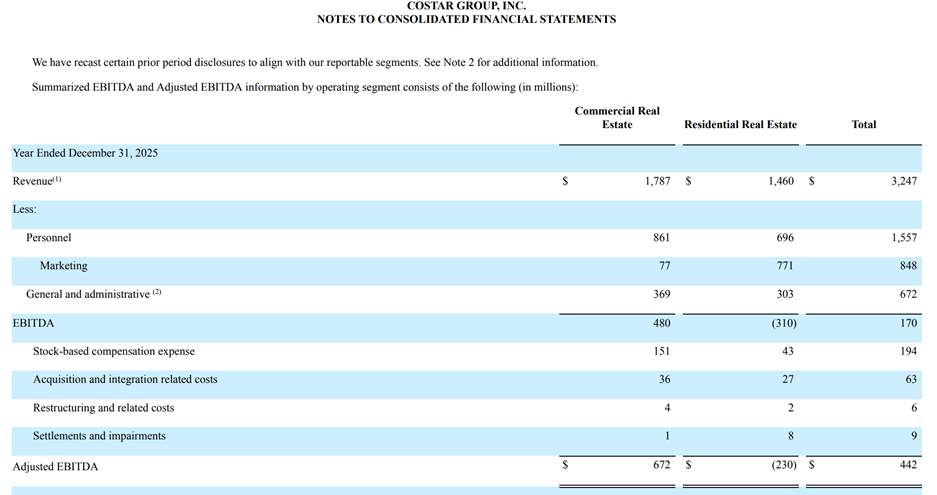
Unfortunately, they have decided to go all in on residential real estate (RRE) and are competing head-to-head with Zillow and Redfin in the US. The vehicle for this competition is homes.com, which they acquired in 2021. With RRE in the U.S. there is something called the MLS (Google it if you’re not familiar) which is a database of property listings that are accessible to real estate agents and websites like Zillow, Redfin and Homes.com. Unlike with CRE, Costar Group has no data edge in residential real estate, so they spend half their revenue on advertising in the hope of attracting buyers to their platforms. They then charge real estate agents to list properties on their platforms. By definition, it’s hard to see this being an attractive business and it’s destroyed the company’s free cash flow over the last few years. Here’s a spreadsheet with summarized financials going back to 2018.
The Current Set Up
The market gave management the benefit of the doubt post the homes.com acquisition, but after two years of negative FCF, investors have lost hope. It’s a pretty ugly five year stock chart.
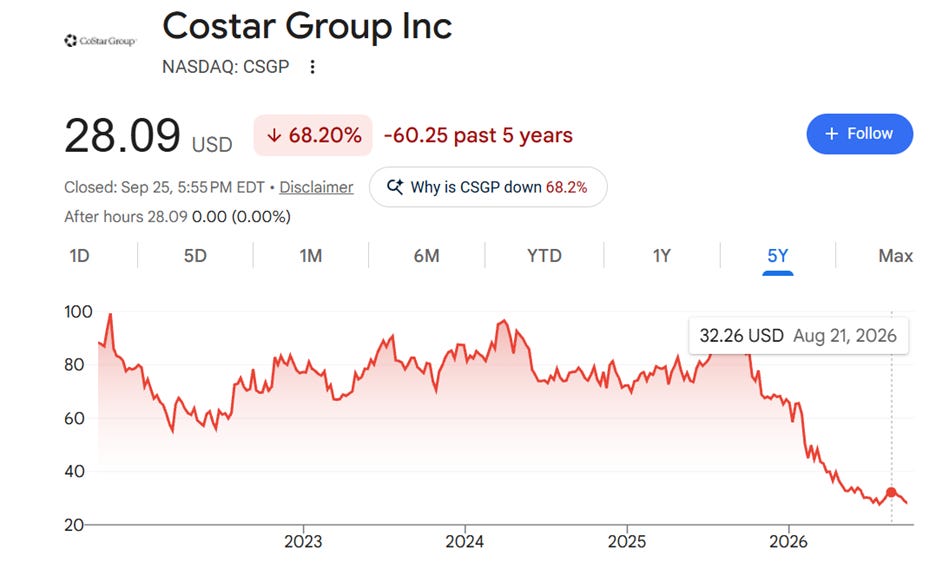
This lack of hope is precisely why I find this to be an interesting set up. Even if their RRE business is shut down / worthless, the CRE business produces about $500m in FCF and is growing topline 6% organically. I think it’s reasonable to pay 20x for this, so $10B in EV seems like fair value. The market cap is currently $11B, but they recently took on $1B in debt from the Zonda acquisition, so the EV today is about $12B.
The ‘reasonable’ downside from here is about 20%, but the stock could easily go down 30-40% if this re rates to 15x FCF.
Now for the upside. Management is claiming that they will stop spending as much on marketing and that the investments they’ve made in RRE are beginning to pay off.
Here is their forecast for adjusted EBITDA.
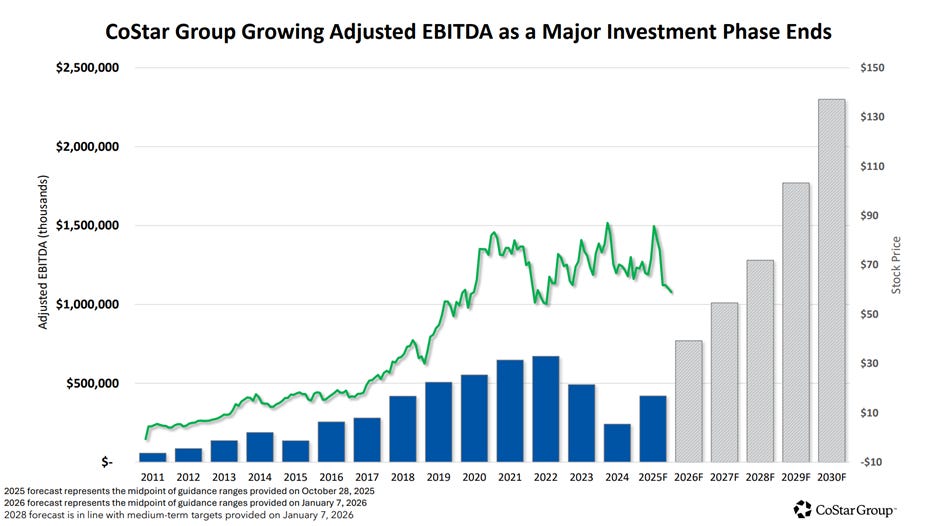
If this pans out, they will be doing about 1.2B in FCF in three years. Put a 20x on that and you have a stock that can easily double.
Even if you think their forecasts are optimistic, it’s easy to see operating leverage kicking in. The commercial business is growing topline 6% on $2B in revenue. There's a world in which most of this flows to the bottom line, so FCF grows by 100m a year. That would imply $0.8B in FCF in 3 years. Putting a 20 – 25x multiple on it, gets you 50-80% upside.
I think this is an interesting asymmetric set up, so I have a 2% position and will consider adding LEAPS if the stock sells off further from here.
Notes
This is a good business, with meaningful recurring revenue. See below from latest 10K.
Revenue from our subscription-based contracts were approximately 93%, 96%, and 95% of total revenue for the years ended December 31, 2025, 2024, and 2023, respectively.
For the trailing 12 months ended December 31, 2025, 2024, and 2023, our contract renewal rates for existing company-wide CoStar Group subscription-based services for contracts with a term of at least one year were approximately 89%, 89%, and 90%, respectively; and, therefore, our cancellation rates for those services during the same periods were approximately 11%, 11%, and 10%, respectively.
Because so much of their revenue is subscription based, I don’t think a slow down in real estate from higher rates should effect them. If anything properties likely sit longer and sellers spend more on advertising.
Revenue from our subscription-based contracts with a term of at least one year were approximately 76%, 81%, and 82% of total revenue for the trailing 12 months ended December 31, 2025, 2024, and 2023, respectively. The decrease in the percentage of our revenue from subscription-based contracts with a term of at least one year from 2024 to 2025 was primarily due to Domain, which sells listings on its platforms on a transactional basis, as well as the transactional products and services sold by Matterport.
To encourage regular use of our services, we generally charge a fixed monthly subscription fee rather than fees based on actual platform usage or number of paid clicks. Depending on the type of service, contract rates are generally based on the number of sites, number of users, organization size, the client’s business focus, the client’s geographic location, the number of properties reported on or analyzed, the number and types of services to which a client subscribes, the number of digital twins hosted, the number of properties a customer advertises, and the prominence and placement of a customer’s advertised properties in the search results
They’ve spent almost half their current market cap on acquisitions in the last two years.
They paid $1.9B for Matterport in 2025. Half stock. Half cash. The stock piece makes sense given the overvalued stock price, but 900m in cash seems foolish.
They paid $1.9B for Domain (an Australian Redfin) in 2025.
$1B for Zonda in 2026
$1B in LT debt – 2.8% due July 2030
Risks
The CEO has almost no stake in the business, which is unusual for a founder led company. I don’t have a good read on how aligned he is with shareholders. This is why it’s a small position today. He has been buying a small amount of stock off late though.
As one of the smallest companies in the S&P 500, they are at risk of being removed from the index, which could trigger additional selling
The CEO continues to double down on homes.com even though the model doesn’t seem to be working. However, there’s nothing like a 60% YTD stock price decline to force a management team to rethink their strategy.