If you’ve ever bought a used car in America, you’ve probably been shown (or asked to see) a Carfax report. This report tells you how many owners the car has had, whether it’s been in an accident, and where it has been serviced. While these reports are not perfect, they do give you a sense of the history of a car.
When you buy a car from a dealer, they will typically provide you with a Carfax report, but you can also purchase one yourself for $50. With the average used car in America costing $27k, buyers are not going to skimp on $50 to avoid a lemon.
Carfax’s main competitor is AutoCheck, but they’re widely regarded as not having as much information (do a Google search on ‘Carfax vs Autocheck’). The AutoCheck report is cheaper at $30, but I don’t think a $20 difference would persuade most buyers to choose a report regarded as inferior.
Carfax gets their data from a network of contributing partners including service shops, police agencies, insurance companies and owners of cars themselves. AutoCheck’s data is primarily from Experian, so it is more focused on title and insurance claim data.
Carfax is Mobility Global’s crown jewel asset. They also offer B2B solutions to OEMs, car dealers and financial institutions, but the margins on those businesses are much lower than on the Carfax piece. See below for segment results.
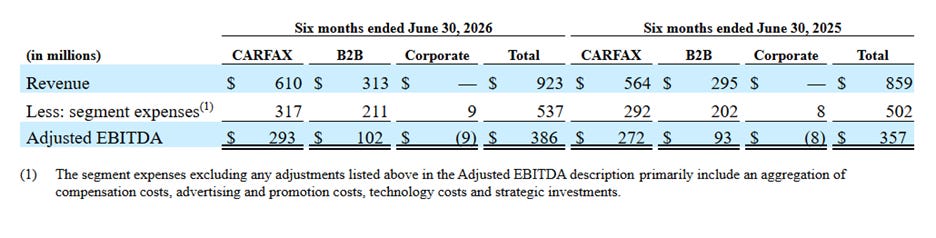
Mobility Global (MBGL) was spun out of S&P Global (SPGI) in July 2026, so the company has only been public a few months. The Carfax business was acquired by IHS for $1.4B in 2013 and S&P acquired IHS Markit in 2020. My sense is that S&P considered this a non-core, low growth asset (7% topline for MBGL in the most recent quarter vs 11% for SPGI) and this drove the decision to spin it off.
For a more detailed overview of MBGL, watch the presentation from their investor day or flip through the deck here.
Scuttlebutt
I spoke to the used car manager at a local San Francisco dealership and he said MBGL charges them a flat monthly fee to pull as many Carfax reports as they want. It needs to be this way because they may pull hundreds of reports a month for cars they’re considering buying, but only end up buying a handful of them. If they had to pay $50 per report, that would quickly become prohibitively expensive. I asked the sales manager what he would do if MBGL doubled the monthly price on him. He said he’d have to pay it because his customers ask for the Carfax, so he would need to make sure any car he’s thinking of buying to resell has a ‘clean Carfax’. This is a testament to the pricing power of this business. The piece that’s less clear is how much Carfax has to pay dealers and service shops to share data with them, and whether their margins can improve over time.
Valuation and Investment Case
We don’t yet have financials for MBGL as a standalone company, as it was still part of SPGI as of the latest quarterly filing. The cost structure of the business is therefore not entirely clear. However, by piecing together information from the investor day and the latest quarter, my sense is the business would generate about $450m in FCF today (excluding one-off spin costs).
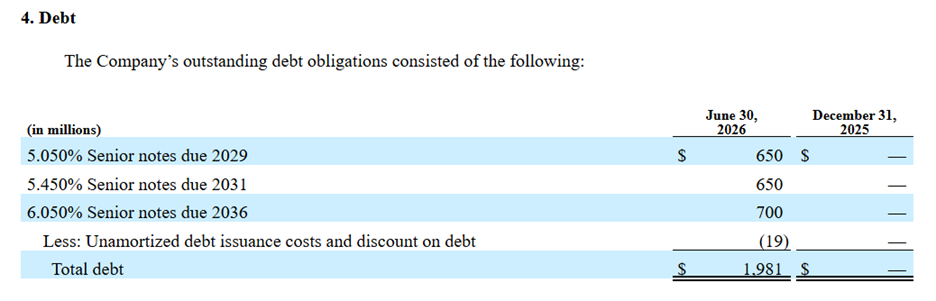
As a buyer of this business I’d want a 6-7% unlevered yield given the 10 year is at 5% today. Unlevered FCF today is about $550m ($100m in interest payments on $2B in debt). A 7% yield implies an enterprise value of 7.9B and a market cap of 5.9B. This is pretty much exactly where the stock trades today.
Based on management guidance, I expect FCF will grow at 8% a year for the next three years putting the unlevered FCF at ~$700m in 3 years. Applying the same 7% yield, the implied enterprise value is $10B. Assuming they use the approximately $1500m in cumulative FCF over the next three years to pay down debt (management has suggested they’d use the cash for buybacks, but hopefully they will only do this if the price is low), this would imply an equity value of $9.5B in three years and a compound return of ~15% a year.
To the extent the market puts a 20x multiple on earnings (not crazy given companies like eBay and Expedia trade at more than 20x and are not growing), MBGL’s stock could 2x in the next three years.
Risks
1. Management could waste money trying to grow internationally or by making poor acquisitions in a bid to boost topline growth. Fortunately, they have said they have no desire to do M&A and have also committed to returning 75% of FCF to shareholders.
2. The B2B business is saturated – already used by 100% of top 40 OEMs, so growth will have to come solely from Carfax.
3. Carfax reports are less useful for electric cars which don’t really have to be serviced. While only 5-10% of new cars sold in the USA today are purely electric, 20-25% of new cars sold in the EU are electric, so Carfax may have a hard time growing there.
Notes
1. They were spun out with a $1B deferred tax liability that will be paid down over 12 years, so they will pay $80m a year in ‘extra’ taxes beyond the normal rate on NI.
2. The reported net income is meaningfully lower than the FCF because there is a running $300m amortization cost for intangibles on the income statement.
3. Here is their debt schedule –